 Plan Your Trip
 True Time
 Rider Alerts
 Schedule Finder
 TrueTime
 Plan Your Trip
 Detours
 Schedule Finder
 TRIP TOOLS
 SEARCH
All PRT buses and rail vehicles come equipped with features that support riders with disabilities. These include:
Digital display boards
Many busway and light rail stations have digital display boards with an audio button that communicate real-time vehicle arrival information. Locations include on the East Busway at Roslyn, Hamnett, Wilkinsburg, Homewood, East Liberty and Negley Stations; on the West Busway at Crafton and Sheraden Stations; and at Lytle, Washington Junction, St. Anne’s, Castle Shannon, Mount Lebanon, Dormont, Potomac, Memorial Hall, South Hills Junction, and Station Square light rail stations.
Stop numbers
To help identify a stop for vehicle tracking, you can find the bus stop numbers affixed to each bus stop sign. The Aira app is also available at each station to help with navigation.
External audio announcements
Once the bus or rail car arrives, route announcements are made outside of the vehicle when the doors open. If for any reason the external announcement does not play, the Operator will call out the route number.
Low-floor buses with ramps and kneelers
Every PRT bus is a low-floor vehicle. Operators can deploy a boarding ramp upon request. All buses can also “kneel,” lowering the first step closer to the curb for easier boarding.
Operator assistance
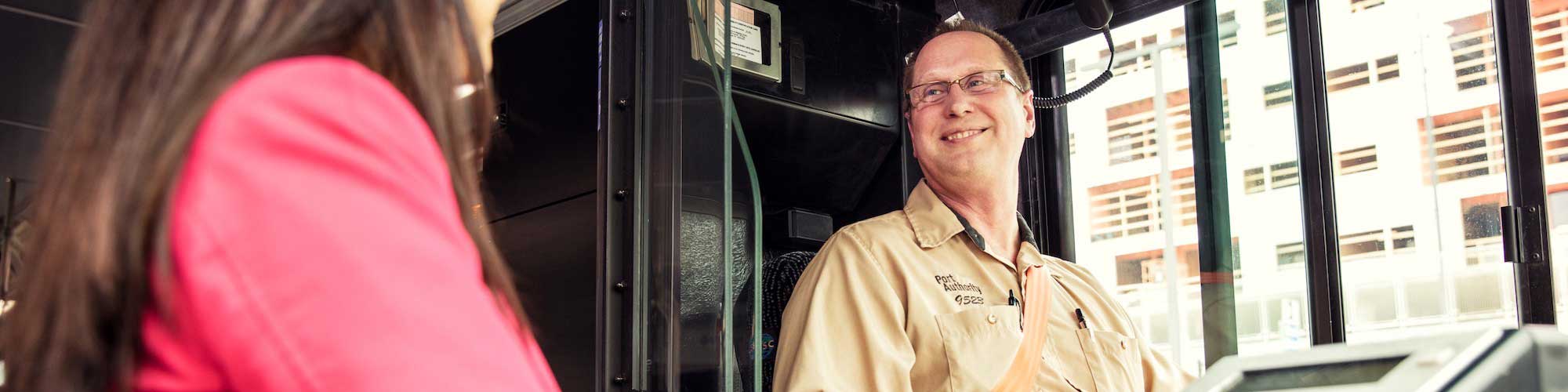
Please ask the Operator for assistance with boarding, finding your seating safely, paying your fare, fastening the securement belts, or other support needed to make your trip a success.
Priority Seating & Securement Area
Priority seating is available near the front of every bus and on all light-rail vehicles.
These seats are reserved for riders with disabilities and senior riders. If you need to be seated to ride safely and the Priority Seating area is occupied, ask the Operator to assist you.
The priority seating/securement areas are intended for riders with disabilities and senior riders.
Securement Belts
Each vehicle has designated securement areas that can accommodate mobility devices.
- Securement belts are recommended, but riders using mobility devices are not required to have their device secured.
- Operators must assist with securement only upon request from the rider
When Not in Use by Priority Riders
- May be used by other riders when not needed by riders with disabilities or senior riders.
- Operators shall ask other riders to relocate if the space is needed to provide priority access.
Large Items in Priority Areas
- Riders with carts, strollers, luggage, or other large items should move to another location if the space is needed.
- Large items must not block aisles or create additional safety concerns and must be collapsed if necessary.
Strollers in the Priority Seating / Securement Area
Strollers may remain open with the child secured inside and parked in the Priority Seating / Securement Area under the following conditions:
- The parent/guardian/caregiver must maintain control of the open stroller at all times.
- The child must remain secured in the stroller for the duration of the ride.
- The parent/guardian/caregiver must maintain the open stroller in a manner that does not block aisles or interfere with other riders.
- The parent/guardian/caregiver is requested to relinquish priority seating to riders with disabilities and senior riders who need to sit in that area.
- If the vehicle becomes too crowded, the parent/guardian/caregiver will need to remove the child from the stroller, and fold/stow it until they alight.
- Children with disabilities are covered under the Americans with Disabilities Act and are permitted to ride in an open stroller at all times.
Bicycles in the Priority Seating / Securement Area on Light Rail Vehicles
- Bicycles must be stowed in the priority seating/securement area.
- Priority access is given to riders with disabilities.
If space becomes limited:
- Riders with bicycles should make room for riders with disabilities.
- Riders should reposition as needed while maintaining safe and secure control of their bicycle.
Stop request indicators
When a rider presses the signal strip or pulls the cord to request a stop, audio and visual indicators let riders know that their request can be seen by the Operator. You can also find a stop button on the back of the seat at each securement area on a bus. If you push this button, it will ring twice so that the Operator knows you will need to use the ramp to exit at the next stop.
Stop announcements
Buses and light rail vehicles automatically announce major stops, intersections, and transfer points. When boarding, you are also welcome to let your operator know where you need to exit so they can let you know when your stop is approaching. If for any reason the automatic announcement does not play, the Operator will call out the stops. The next stop also automatically displays at the front of each bus or rail car - as well as at the center of the longer, articulated buses.